At a glance
- San Simone ai Coronari is a 12th-century church in Rione Ponte, between Via dei Coronari and Monte Giordano, a few steps from Piazza Navona.
- Once the baronial chapel of the Orsini family, it was deconsecrated in 1902 and later became a cinema, a theatre and a restaurant.
- Today it is commercial premises (cadastral category C/1) of about 300 m², offered for sale by private negotiation through Studio Fori.
The place
On the Monticello, in the shadow of the Orsini
Walking down Via dei Coronari among the antique shops, you might barely notice that, set back slightly from the line of the houses, there is the façade of a medieval church. This is the former church of Saints Simon and Jude, built as the baronial chapel of Monte Giordano, the stronghold the Orsini family raised between the 11th and 12th centuries on a small rise above the bend of the Tiber.
That set-back position is no accident: over the centuries the façades of the palaces along Via dei Coronari advanced towards the street, leaving the church behind and reached by a flight of steps. The interior, too, was transformed several times, following each change of ownership and function.

Nine centuries of names
From Santa Maria in Monticellis to Saints Simon and Jude
The church was consecrated by Pope Paschal II, pontiff from 1099 to 1118, and again by Innocent II in 1143: an inscription still records it. Its first name, Santa Maria in Monticellis, refers to the small hill on which it stands. Around the mid-12th century it became Santa Maria de Monte Johannis Ronzonis, after Giovanni di Roncione, lord of Riano.
Saints Simon and Jude appeared alongside the Virgin in the 15th century, and since the mid-16th century the church has borne their name. From the 16th century until its deconsecration it remained under the patronage of the Orsini, and in 1720 it was restored at the wish of Pope Clement XI.
Christmas 1598
The chronicles collected by Panciroli and later by Hülsen tell how, during the great Tiber flood of 1598, the water swept through the whole district but not the church: on Christmas night the rise of the Monticello kept it dry. A detail that also explains why, even today, you climb up to the entrance.
After 1902
Cinema, theatre, restaurant: a second life
In 1902 the church was deconsecrated and put up for auction by Prince Filippo Orsini; the burials were moved to the portico of San Silvestro in Capite. The building was divided: one part became a home, the other the Alcazar cinema, also remembered as a café-chantant linked to the actor Ettore Petrolini.
During the Fascist period the hall housed in turn a cinema, the party’s after-work leisure club, a carpentry workshop, a theatre and a restaurant, before becoming a theatre once again. The sequence says a great deal about the space: a large, tall, open room, able to host the most varied functions without losing its identity.


The architecture
What remains of the medieval church
The building is set between two side wings, within a three-storey block, and is preceded by the staircase to the main entrance. A second entrance, also with an outdoor staircase, opens on the side along Via della Vetrina.
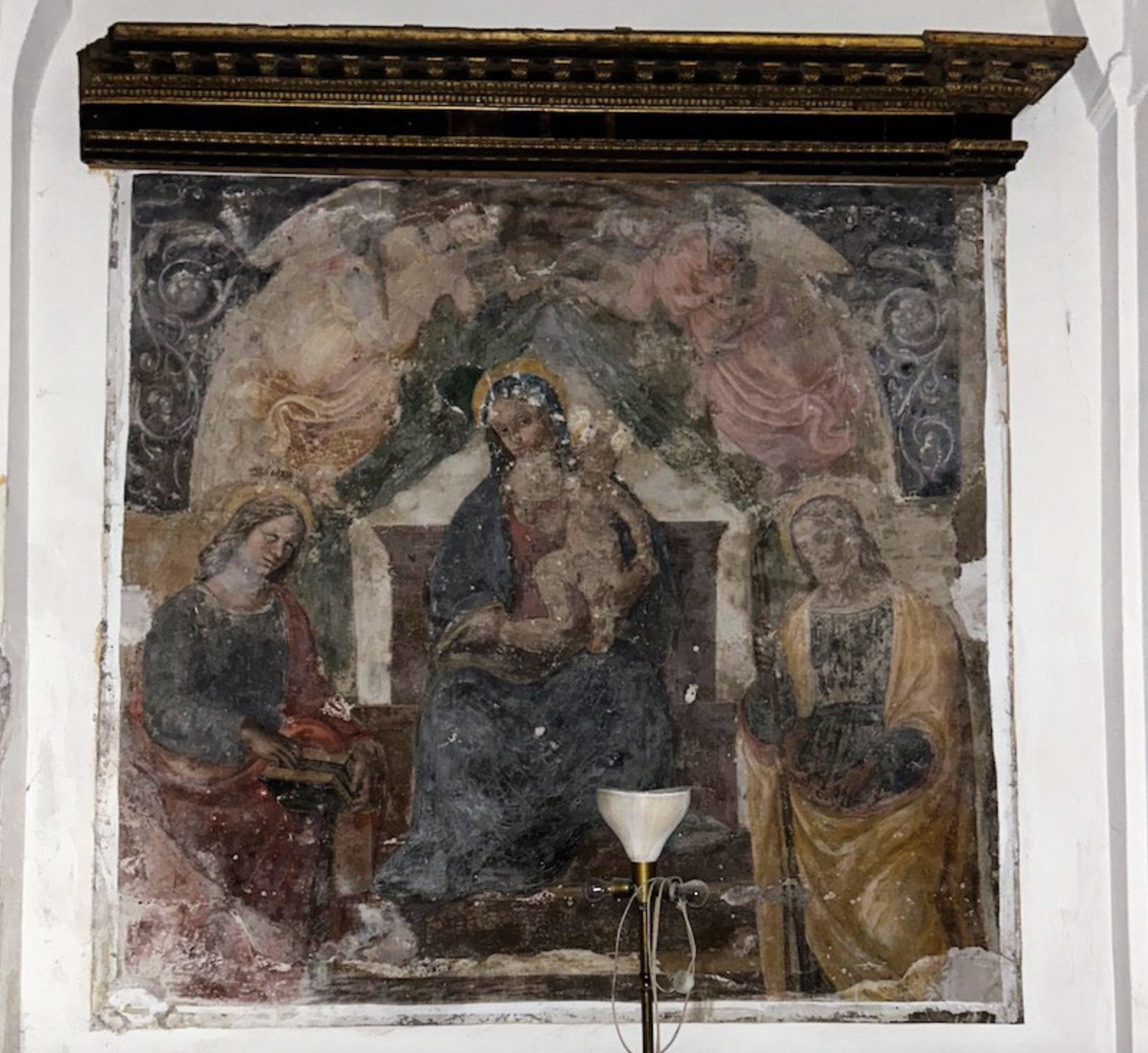
The plan has three naves: the central one now forms a single large open hall, up to about 7 metres high, while the side aisles were divided into rooms during the building’s later uses. Fragments of 14th- and 15th-century frescoes survive and, above all, a Madonna and Child with Saints of the Umbrian-Roman school, attributed to pupils of Antoniazzo Romano and, according to some, to Perugino. The fresco’s original frame is now dismantled.
Buying a church
What to know before buying a sacred building
A deconsecrated church is bought like any other property, with a notarial deed, but with a few extra checks. They make the difference between an evocative idea and a project that can actually be carried out.
Secular use
The reduction to secular use is an act of the Church authority: for San Simone it took place in 1902. Future uses should still respect the history of the place.
Cultural property
It must be established whether the building is formally declared of cultural interest: if so, works require the approval of the Heritage Authority (Soprintendenza) and the State has a pre-emption right on the sale (art. 60, Legislative Decree 42/2004).
Category C/1
The property is currently registered as commercial premises: a good base for a gallery, showroom or business open to the public. Other uses require a change of use compatible with the historic-centre regulations.
Permits and energy
Events, performances or dining require checks on capacity, fire exits and services. The current energy class is G: improvements must be designed to suit a historic building.
On these aspects we prepare a property due diligence before any purchase offer.
The future
What it could become
The history of San Simone already suggests the answers. An art gallery or a showroom on the street of antique dealers; a venue for events, launches and private dinners; a small theatre or concert hall, as it once was; the headquarters of a foundation, a cultural institute or a fashion house; an archive or a private collection. Each scenario has its own checks, but all share the same strength: a hall of about 300 m² in the centre of Rome, virtually impossible to find on the market.
For prospective buyers, architect Alessandro Mori prepares a preliminary reuse design for the chosen scenario, included in the agency fee.
 For sale · private negotiationFormer church of San Simone ai CoronariRione Ponte · about 300 m² · category C/1 · plans, photos and details on the property pageSee the property →
Frequently asked questions
Where is the church of San Simone ai Coronari?
In Rione Ponte, in the historic centre of Rome, between Via dei Coronari and Monte Giordano, a few steps from Piazza Navona.
Can you buy a deconsecrated church in Rome?
Yes: a church reduced to secular use can be privately owned and sold with an ordinary notarial deed. If it is declared cultural property, the sale must be notified to the Ministry of Culture, which may exercise its pre-emption right, and any works require the approval of the Heritage Authority.
What can San Simone ai Coronari be used for?
It is currently commercial premises in category C/1, suitable for example as a gallery or showroom. Uses such as events, theatre, dining or representative headquarters require safety and permit checks and, in some cases, a change of use compatible with the historic-centre regulations.
Can foreigners buy property in Italy?
Citizens of the EU and of countries with reciprocity agreements with Italy can buy freely; others may need a residence permit. Studio Fori assists international buyers in English throughout the process, from the tax code to the notarial deed.
How can I view the property?
The sale is by private negotiation: full documentation and viewings are reserved for qualified parties, on request to Studio Fori.

Arch. Alessandro Mori · Real estate agent since 1996 · Via Monte Brianzo 78, Rome
+39 06 9818 4453 · WhatsApp +39 333 250 5170 · in**@********ri.com